Adhesives: A Master Class

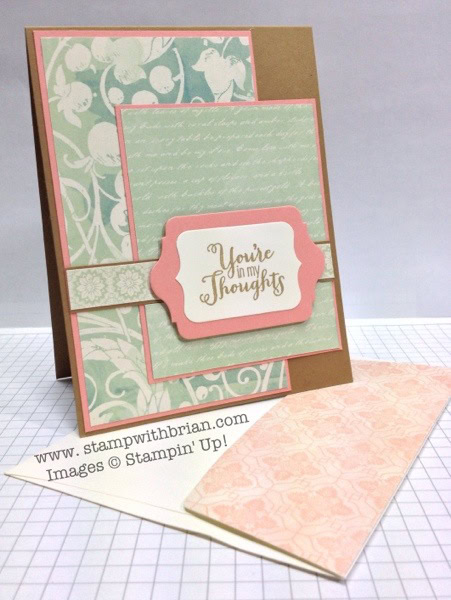
Yesterday, I shared this baby card for The Paper Players: www.stampwithbrian.com

After I completed this card, I realized I had inadvertently made a card that would make for a great discussion of Stampin’ Up!’s line of adhesives. Here’s a quick rundown of the adhesives I used with a quick explanation of why I used them:

Snail Adhesive - by Stampin' Up!

  • SNAIL ADHESIVE. I find that SNAIL Adhesive is the best way to attach thin papers like Whisper White, Very Vanilla or Designer Series Paper. The adhesive is permanent and won’t warp the thin paper (when using Multipurpose Liquid Glue on these thin papers, make sure to apply a very thin layer, or it will warp the paper a bit). I used SNAIL Adhesive on the Whisper White circle and to attach the large piece of Daffodil Delight Designer Series Paper.

Tombow Multi-Purpose Adhesive - by Stampin' Up!

  • MULTIPURPOSE LIQUID GLUE. I was hesitant to use this liquid glue at first. I’d been using monadhesive for years and didn’t want to change – I’m brand loyal AND change adverse. I gave Multipurpose Liquid Glue a try, though, and find that it’s perfect for attaching card stock and thin papers that have to be exactly placed. I affixed the 2-1/2″ Marina Mist circle with Multipurpose Liquid Glue. Within the first couple of seconds of attaching the circle, I could still move the circle to line it up exactly.

Sticky Strip - by Stampin' Up!

  • STICKY STRIP. Sticky strip is a perfect adhesive to attach ribbon or for any permanent holds (e.g., assembling 3-D projects). I used Sticky Strip here to attach the scallop ribbon and to attach both ribbons to the backside of the cardstock.

Mini Glue Dots - by Stampin' Up!

  • MINI GLUE DOTS. Not only are Glue Dots adorable, they are also effective for attaching small objects. On this card, I used Glue Dots to attach the Daffodil Delight Stitched Ribbon and to attach the faux bow. Here’s a “duh” trick I figured out: roll out the sheet with the glue dots on it, press the bow against the strip to remove the dot and then attach the bow to the card. This is much easier than pealing off a glue dot and transferring it to the area that needs to be added.

Crystal Effects - by Stampin' Up!

  • CRYSTAL EFFECTS. Crystal Effects is a clear globby glue (I don’t think Stampin’ Up! defines it that way). It comes out of the bottle with ease and has a smokey tint to it at first, but it dries clear. It’s a perfect tool for adding a 3-D appearance to projects – just spread it on and let it dry. Here, I used it to attach the three heart buttons. I made sure to add the Crystal Effects to the entire back of the button so that it wouldn’t dry uneven.

Stampin' Dimensionals - by Stampin' Up!

  • STAMPIN’ DIMENSIONALS. Must I say more? If you have ever looked at another post of mine, then you’ve seen Stampin’ Dimensionals. I love them. They are good for anything. You must have them. I just might have a video coming about them. End of discussion.

An Adhesives Summary

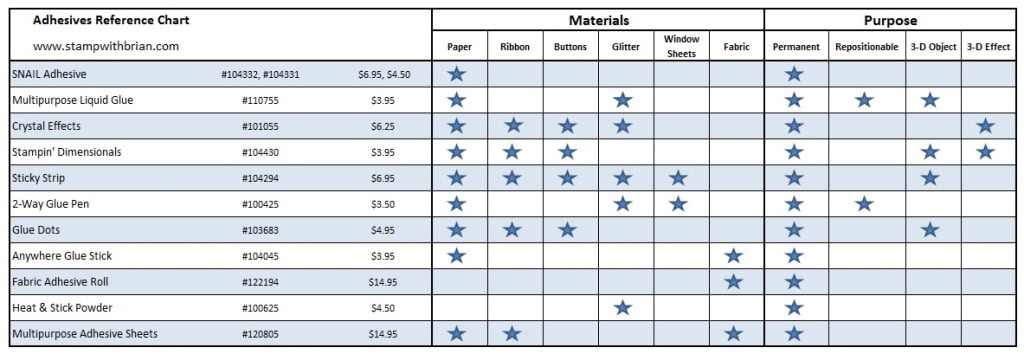
I created this reference chart to help you when making your adhesive choices. Click on the image below to reference a .pdf of the chart that you can print out and post in your craft space. You’re welcome. :) stampwithbrian.com - Adhesives Reference Chart

Now, head on over to www.stampwithbrian.stampinup.net to stock up on these adhesives so that you’ve got plenty on hand when you need them.

I won’t leave you hanging without a new project. I’ve learned that lesson before, so here’s a sneak peek at the project I’ll be sharing tomorrow. If THIS won’t draw you back, then NOTHING will:20130217-201142.jpg

Thanks for stopping by my blog today!

Brian
Follow Me on Pinterest button

My Stampin’ Clubhouse. Don’t get left out. We’re almost full, and I can’t wait to get started! If you’ve been thinking about joining the club, now’s the time! Members will have access to special projects and products from me – as well as earn hostess benefits in the month that they are the hostess. Click here to learn more about the Stampin’ Clubhouse. Send me an email (stampwithbrian@gmail.com) now to reserve your spot in the club.


New Trimmer Pictures and Old Trimmer Trick

Today, I have a little bit more information about Stampin’ Up!’s brand new Stampin’ Trimmer – and a special tip about the old paper trimmer.

The Brand New Stampin’ Trimmer

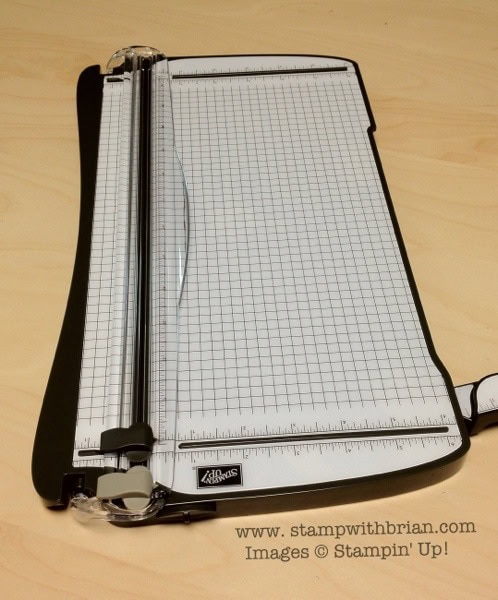
You’ve probably heard about it by now, but…the Stampin’ Trimmer is available for you to order now.  Place your order here.  I don’t understate it when I say this puppy is beautiful.  A paper trimmer sounds so basic, but this one was designed just for us!  As a demonstrator, I was able to order mine early – it arrived this week, and I love it.  Here’s a snapshot of my new love:20121030-205106.jpg

And a closeup:20121030-205113.jpg

What I love most about the trimmer is that the base is long enough for most of our card-making projects.  With the old trimmer, I had to extend the arm for everything – whether I was scoring or cutting at 5-1/2″.  Not the case here!  This base extends beyond 6″.  When you do need to extend the arm, though, it lifts to extend to base of the trimmer.  You’ll love it, too!  Go buy one now.

Exclusive Tip on the Old Trimmer

Thanks for taking pause from my blog to order your Stampin’ Trimmer.  Welcome back.  For those of you who have ordered a trimmer from me, I have an exclusive tip for using your old trimmer (you still have to use it while you wait).  If you haven’t bought a trimmer from me, please stop reading now.  OK, OK, you can read it, too.  But…wait…a…minute!  How would you know I said you could read it unless you kept reading even after I told you to stop?  You are a devilish one.

While I was working on my Big Secret project this past weekend, I needed to score a whole bunch of paper at 5-1/2″.  It’s really annoying because I have to extend the arm AND guess at the placement at 5-1/2″ (the arm is below the base, so you have to really study it hard).  Being a “there’s got to be an easier way” kinda’ guy, I came up with a solution:

  • I grabbed a pad of post-it notes (this ideas is brought to you by my first corporate sponsor, Vanguard).
  • I peeled off the back page of the pad and stuck the stack of stickies at the 5-1/2″ mark.20121030-205122.jpg
  • With my post-it pad in place, I could easily slide my paper along the bottom of the trimmer and stop when I reached the pad of notes.20121030-205129.jpg
  • Score or cut, and you are done.  Easiest solution ever.

Thanks for stopping by my blog today!

Brian

You’ve Entered a New Stampin’ Dimensional

If you are a heavy crafter like I am (maybe I should say “dedicated crafter” – sounds so much nicer than “heavy crafter”? By the way, I’ve been meaning to ask if you’ve lost a little weight. You look so healthy!)…where was I? Oh, yes, if you are a dedicated crafter like I am, then you’ve probably stumbled upon little white hexagons in hidden corners of your house – in the car, under the bed, in your shopping bag, in the back of the fridge. It’s a sure sign that you’ve been using your Stampin’ Dimensionals!

stampwithbrian.com - other uses for Stampin' Dimensionals

It’s rare that I ever complete a project without adding a dimensional or two. They’re just so easy to use! Here are the features & benefits of these delightful foam adhesives as provided in the Stampin’ Up! product guide:

  • Double-sided, self-adhesive foam mounts
  • 1/16″ diameter
  • 300 per package
  • Use multiple Stampin’ Dimensionals for multilevel projects or added height
  • Great for layering and 3-D effects

These are all good, but Stampin’ Dimensionals aren’t just for raising up a piece of paper on card stock. Here are a few other ideas for using up that pack of 300 dimensionals, giving you an excuse to place another order:

Table balancer. I was setting up for a workshop at my house last weekend. When I rearranged the tables, one of them was wobbly. I didn’t have a packet of Sweet ‘n Low around (that’s what they use the restuarants), and I didn’t want a big paper towel sticking out from under the table. Instead, I reached for my handiest crafting tool, my Stampin’ Dimensionals. I popped two of them out, stacked them on top of each other (leaving the hexagon sticker in tact) and stuck them on the bottom of the table leg. Eureka!

Wall protector. Did you just have the walls painted in your living room? That’s a gorgeous paint color! Having second thoughts about hanging up that picture because the bottom will scrape up against the wall? Add a dimensional on either side (again, leaving the hexagon sticker in tact), and you’re good to go. Crisis averted.

Cabinet stop. When you slam you kitchen cabinet doors, do the walls shake? Easy peasy. Stick a dimensional between the cabinet door and the base of the cabinet. It’ll soften the blow (and look adorable doing it).

Once you’ve used all the hexagon dimensionals to balance all the tables in your house and to protect all your walls from those pesky pictures, don’t throw away the edges. Snip those off and use those, too. AND don’t forget that the waxy-like surface of the dimensionals paper is perfect for adding monoadhesive to small surfaces. The adhesive won’t stick, so you won’t make a mess.

Thanks for stopping by my blog today.

Brian

Want to make your own Triple Time Stamping cards? Buy your kit from me here!

Organizing My Stampin’ Up! Punches

Before this year, I only owned three punches. I wasn’t really sold on the idea that they were necessary. With a very open mind, though, I purchased one new punch in March. That lead to three punches. Now I have a shelf full of them. They are essential!  (I went through the same process with the Big Shot and Framelits, but I’ll save that story for another day).

I’ve seen all the pictures of how very crafty people use IKEA rails to store their Stampin’ Up! punches. Despite Stampin’ Up!’s suggestion that punches should be stored in the “locked” position (to prevent loosening of the inside coils), I have to admit that I would LOVE to have them on display for all to see. There’s something very appealing about being able to see it all. At the same time, there’s something very appealing about putting it all away. :)   What a predicament!  I am quite happy with my method of storing my punches, and I want to share it with you.

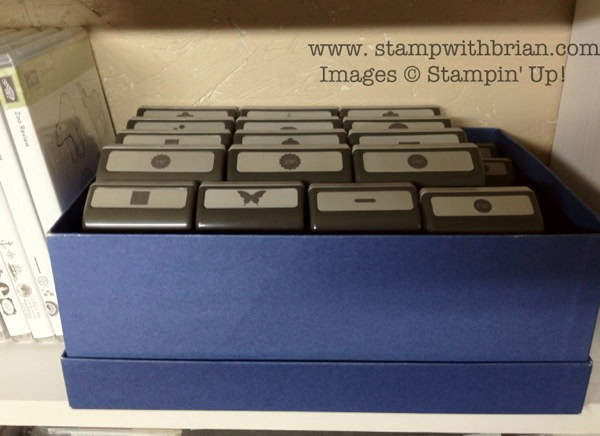
I store my punches in a cheap photo box on the shelf behind my desk. Stampin’ Up!’s punches are labeled both on the top of the punch and the handle of the punch.  When they are stored vertically (handle side up), I can easily see all of the punch labels. When I am reaching for a particular punch, I don’t have to look far. And if I want to see all my punches while I am stamping, I can just grab this 78.8 pound photo box, and lug it to my table.  AND look at how perfectly and how snuggly they all fit in the box. It’s almost like the box was made just for these punches…or perhaps the punches were actually made for this box.
stampwithbrian.com - organizing punches

How do you store your punches?  In a drawer?  On a rail?  At a store?  With a snail?

Accessories: Lots and lots of punches

Thanks for stopping by my blog today!

Brian

Introducing: The Aqua Envelope Sealer

On Tuesday and Wednesday, I prepped and mailed some cards and gifts to friends in different parts of the country. I cringed with disgust every time I lifted the gluey envelope flap to my mouth. The idea of running my tongue over the dried glue strip made chills run up my spine. Still, I followed through on the deed with several envelopes – one after another after another. Cringe, disgust, lift, lick, chills, regret. Cringe, disgust, lift, lick, chills, regret. Cringe, disgust…you get the picture, right?

That’s when eureka jumped up and slapped me in the face! Why couldn’t I use my old Aqua Painter to wet the glue on the back of the envelope?
20120904-200936.jpgThat’s the day when envelope sealing became a joy, instead of a chore. And everyone lived happily ever after.

While we are talking about the Aqua Painter (incidentally one of my favorite Stampin’ Up! tools), here are some interesting facts about the Aqua Painters:

  • Aqua Painters retail for $16.95 in the Stampin’ Up! Idea Book and Catalog.
  • Aqua Painters are sold in sets of two: one has a 12mm brush tip, and one has a 15mm brush tip.
  • The Aqua Painter reservoir hold 8 cc of liquid (assumably water).
  • Sally Jesse Raphael owns 17 sets of Aqua Painters.

OK, so maybe I made up that last point because her name is so fun to say.  Don’t you agree?

Accessories:  Aqua Painter, envelope (works with any Stampin’ Up! envelopes)

Thanks for stopping by my blog today!

Brian
Follow Me on Pinterest

Vinyl Sheets for Better Cling-ability

Stampin’ Up! offers two choices for most of it’s stamp sets: wood mount or clear mount.

  • Each of the wood mount stamps come with a coordinating wood blocks. No work to switch between stamps. You just clean it off, put it back in the case and grab the next stamp.
  • Clear mount stamps are stored in DVD cases and are easier to organize (and you can pack up more of them when you want to travel to my house to stamp with me). You adhere the clear mount stamps to an acrylic block when you are ready to stamp with them. In my opinion, the clear mount stamps are infinitely better than the wood mount stamps with the exception of small stamps (like Teeny Tiny Wishes) that are more difficult to adhere and unadhere from the acrylic blocks – I prefer wood mount stamps for these little ones.

There’s only one problem with the clear mount stamps: when fully assembled according to the instructions in the stamp case, they don’t really hold tight to the acrylic block like they are supposed to. They pop off the acrylic block when you are inking them up or when you are cleaning them. That’s not very excellent, now is it? When the clear image of the stamp is adhered to the clear mount foam on the back of the stamp, some of the stamp’s cling-ability is lost. That’s why you’ll see a lot of online videos from amazing Stampin’ Up! demonstrators who have decided to NOT adhere the clear image to the back of the stamp. That’s no good! I want to see the image I am stamping. I want it to work the way it should work.

I have found the solution. After reading about several demonstrators who found cheap clear vinyl at the big box stores, I did some investigating and purchased a high-quality, clear vinyl that’s sold in large rolls. 

I cut the vinyl into sizes that fit on each of my acrylic blocks:
20120819-155250.jpgI pealed off the vinyl and attached it to my block:
20120819-155307.jpg and then pressed on my stamp (clear label and all):
20120819-155317.jpgThat puppy ain’t moving until I move it. :)   You can just keep the vinyl on your acrylic blocks, and it’s ready for the next stamp you want to adhere.

As an independent demonstrator for Stampin’ Up!, I am unable to sell these vinyl sheets (even though they infinitely enhance the stamping experience). I am, however, able to offer you these vinyl sheets as an incentive or bonus. Because this has changed my stamping experience, I really want you to try it. That’s why I am offering you a set vinyl sheets (cut to the size of a set of Stampin’ Up! acrylic blocks) when you place an order directly from my demonstrator site here. When you place a $50 order, I will mail you the vinyl sheets that coordinate with the Clear Block Starter Bundle (C, D and H).  When you place a $100 order, I will mail you the vinyl sheets that coordinate with the entire bundle of Clear Blocks (A through I).  I hope you’ll give it a try!  You’ll be ready to adhere those images for a complete stamping experience.

Please email me at stampwithbrian@gmail.com if you have any questions!

Thanks for stopping by my blog today!

Brian
Follow Me on Pinterest

Punch Identification: A Circle Circus Story

How many times have you stamped a myriad of Circle Circus images on scrap paper and then been stuck as to which punch you needed to finish the desired look?

OK, so you might have a ring with all your punched out images so you can size everything up at a moment’s notice. You might have a chart in your drawer that lists them all out. Well, thanks to an idea from Allie Giel (one of my newest downlines and the “Queen of Circle Circus”), I now have a reference chart just inside my Circle Circus stamp box that gives me everything I need. It’s a brilliant and easy way to categorize the punches needed for a particular set.  Here’s what I’ve created:

Side 1

20120819-160831.jpg

I just set the chart inside the cover of my stamp set for quick and easy reference.

Side 2

20120819-160847.jpg

20120819-160856.jpg

How simple and easy is that?  I really love this idea and will be organizing my other sets in a similar fashion.

Why do I have that paper stuffed into my wood mount set?  Perhaps you missed my blog with that suggestion?  Check it out here.

Thanks for stopping by my blog today!

Brian
Follow Me on Pinterest

Stair Step Step-by-Step

Last week, I shared this card, a gorgous stair step card I cased from Katy McGloin (why not get one last “ooh and ahh” out of this card?):
20120819-154200.jpgKaty credits Splitcoast Stampers for the original tutorial for this card, but the original card design would not fit into a standard-sized envelope.  Because Katy only accepts perfection, she worked tirelessly to reconfigure the design, and she succeeded!  Last week, I shared Katy’s drawing of the cuts and scores to make this card.  I received a lot of feedback and requests from readers (I actually have a few readers!) who wanted to see a step-by-step tutorial of this stair step card. You ask, and I deliver!

TUTORIAL FOR STAIR STEP CARD:

  • Start with a piece of card stock trimmed to 10-1/2″ x 4″.  I used Perfect Plum for this tutorial because the cuts and score lines seemed to photograph well.  I don’t use Perfect Plum very much and have lots of it sitting around, so there’s a bonus!

20120819-154236.jpg

  • Place the paper on your paper trimmer.  One inch from the edge of the card stock, cut a straight line from the 2″ mark to the 7-1/4″ mark:

20120819-154249.jpg

  • Turn the card stock around.  One inch from the edge of the card stock, cut a straight line from the 3-1/4″ mark to the 8-1/2″ mark.  Notice how the two cuts are lined up:

20120819-154321.jpg

  • Your trimmed card stock should look like this:

20120819-154358.jpg

  • One end has a large, untrimmed space (where my handsome thumb is in this above picture), while the other side has a small, untrimmed space.  Position the card stock in the trimmer where the large space is on your left. 
  • At 7-1/4″, score the card stock from the 1″ cut to the end of the card stock (on both sides of the card stock).
  • At 5-1/4″, score the piece of card stock between the two cuts.
  • At 4″, score the card stock from the 1″ cut to the end of the card stock (on both sides of the card stock).
  • Here’s a whole mess of pictures to depict those instructions:  

20120819-154406.jpg

20120819-154417.jpg

20120819-154423.jpg

  • Here’s what your scored and trimmed piece of card stock looks like now:

20120819-154432.jpg

  • and scored:

20120819-154439.jpg

  • and folded:

20120819-154446.jpg

  • and displayed on the table:

20120819-154454.jpg

Thanks for stopping by my blog!

Brian

Follow Me on Pinterest

Organizing – Sponges and Sponge Daubers

I’ve said it once, and I’ll say it again – this hobby of stamping is actually comprised of three very separate hobbies:  collecting, creating and organizing.  Today, I want to offer some organization tips for your sponges and songe daubers. 

Stamping sponges and sponge daubers are two of the handiest (but most underutilized) tools in my craft room.  Both are perfect for adding texture and color to projects.  Just dip them into an ink pad and then smear or tap away!

  • Stamping sponges.  The sponges are really large and come in a pack of three.  I use my craft scissors to cut the sponges into fourths, so I can get 12 sponges out of a pack (and still have the surface of the sponge necessary to complete daubed effects).    
  • Sponge daubers.  The sponge daubers come in a pack of 12.  The daubers fit perfectly on my finger like a tiny little finger puppet and are also perfect for adding color and texture.

So that I don’t have to constantly monitor the color of the sponge I am using, I assign one sponge and one sponge dauber to a color and store them accordingly.  I found this sewing notions plastic storage container some years ago.  I have two of them and store all of my sponging accessories in them.  With a hook on the side, they hang easily on the wall in my craft space:

20120817-215552.jpg

I labeled the colors in the back ”wall” of the individual container spaces and drop in the associated sponge quarter and sponge dauber: 

20120817-215603.jpg

To easily segregate and identify the color identity of the sponges, I punched a scrap piece of the associated color card stock with the Decorative Label punch, scored it and folded it in half.  I pinched the part of the sponge that had previously been the inside of the sponge and stapled the label in place.  Now, I have a perfect, little handle to hold the sponge and get to coloring! 

Accessories:  Sponge Daubers, Stamping Sponges, Decorative Label punch

I hope you like this storage idea.

Thanks for stopping by my blog today!

Brian

Follow Me on Pinterest

Googly Ghouls (part 2) – The Envelope

In yesterday’s post, I shared this Googly Ghouls Halloween card as a part of the Pals 2012 Holiday Catalog Blog Hop:

20120812-175726.jpg

I mounted the ghouls on a long, slender card that would easily fit in a standard business envelope – the Basic Black base measures 9″x7-1/2″ and is scored at 3-3/4″ to make a 9″x3-3/4″ card front.  Rather than stick this beautiful card in a plain, legal envelope, I decided to make a coordinated, stylish envelope for its delivery.  Today, I want to share the step-by-step instructions for making this envelope: 

  • I cut a piece of Pumpkin Pie Designer Series Paper Stack paper to 9-1/4″x11-3/4″.  I chose this DSP with stripes as the exterior of the envelope.  I wanted the lines to extend the length of the envelope, so I ensured the lines were horizontal on the 11-3/4″ side.
  • I placed the paper on the Simply Scored Scoring Tool with the shortest end of the paper lined up against the top ruler. 

20120812-151409.jpg

  • With the markers at 2-3/8″ and 6-1/2″, I scored the horizontal lines of the envelope.  Look at me scoring!

20120812-151421.jpg

  • I then turned the paper on its side and scored it 1-1/2″ and 11″.
  • I trimmed the corners off the scored piece of paper, careful to snip on the inside of the scoreline so that everything would fold over cleanly:

20120812-151433.jpg

  • With the 3/16″ Corner punch, I rounded all the corners:

20120812-151444.jpg

  • I folded the envelope, using my bone folder to make sure that the envelope completely closes:

20120812-151453.jpg

  • I added adhesive to the shorter side panel and then glued down the longer side.

20120812-151500.jpg

  • And then added adhesive to the bottom panel (the shortest of the remaining panels) and glued it down.20120812-151507.jpg
  • I then sat back and smiled because I had a pretty awesome envelope that opens from the top and that makes for an amazing delivery system for my dancing, little ghouls.

Paper:  Bold Designer Series Paper Pack (Pumpkin Pie)  Accessories:  Simply Scored Scoring Tool, Simply Scored Stylus, Bone Folder, 3/16″ Corner punch

Thanks for stopping by my blog today!

Brian